XIAO GUO HUI
THIS SIDE OF THE MOUNTAIN, THE OTHER SIDE OF THE WATER
17 September - 14 November 2026






Exhibited works:



PRESS RELEASE in English (deutsche version unten verfügbar)
[PDF]
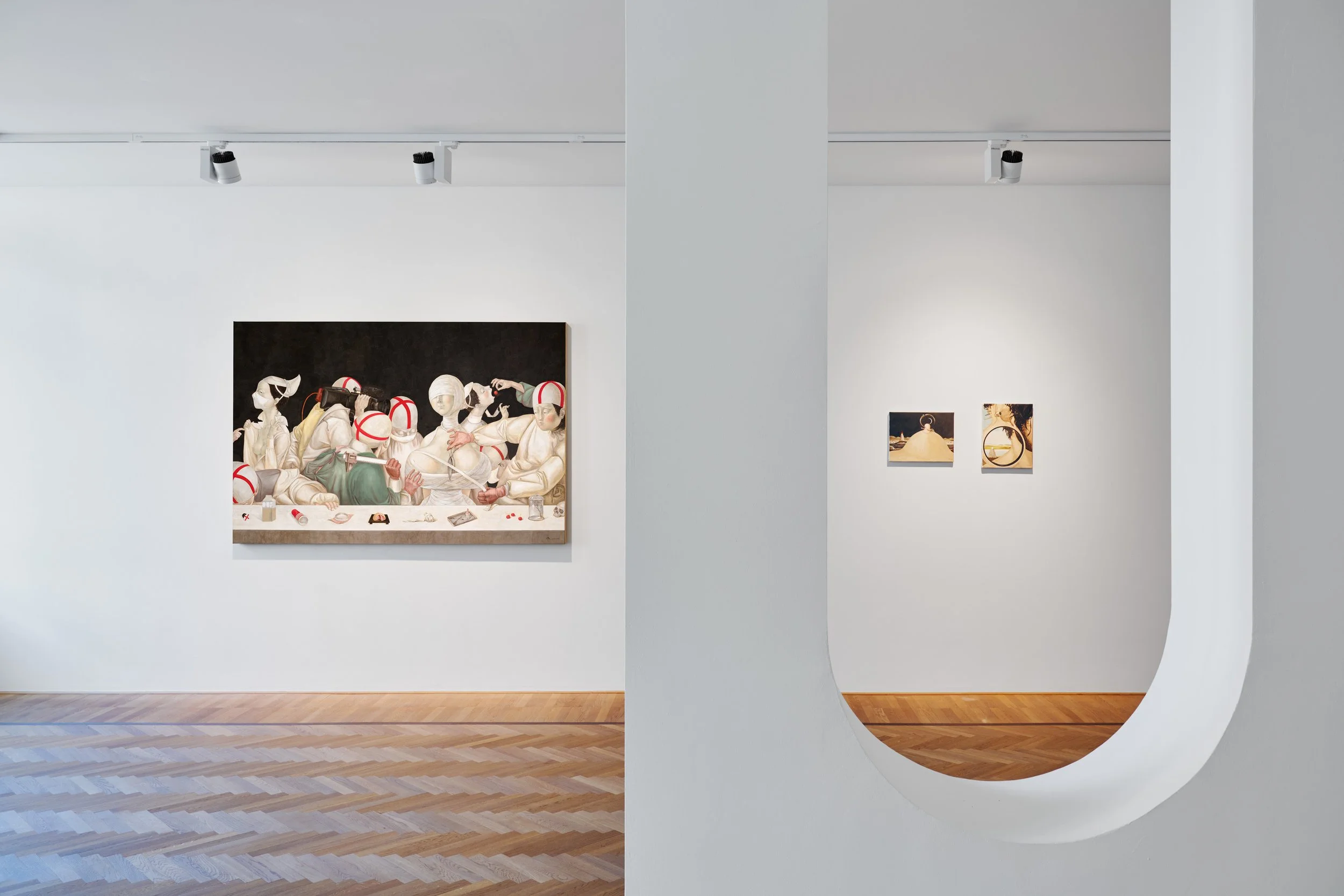
Galerie Fabian Lang is proud to present its second solo exhibition of works by Xiao Guo Hui, a two year long inquiry into the ontological capacity of contemporary painting. Building upon his inquiry into what painting can achieve in an age saturated with digital media, this new body of work uses human conflict, the theatre of conviction and the quiet mechanics of everyday life as its point of departure to observe the contemporary "Human Comedy".
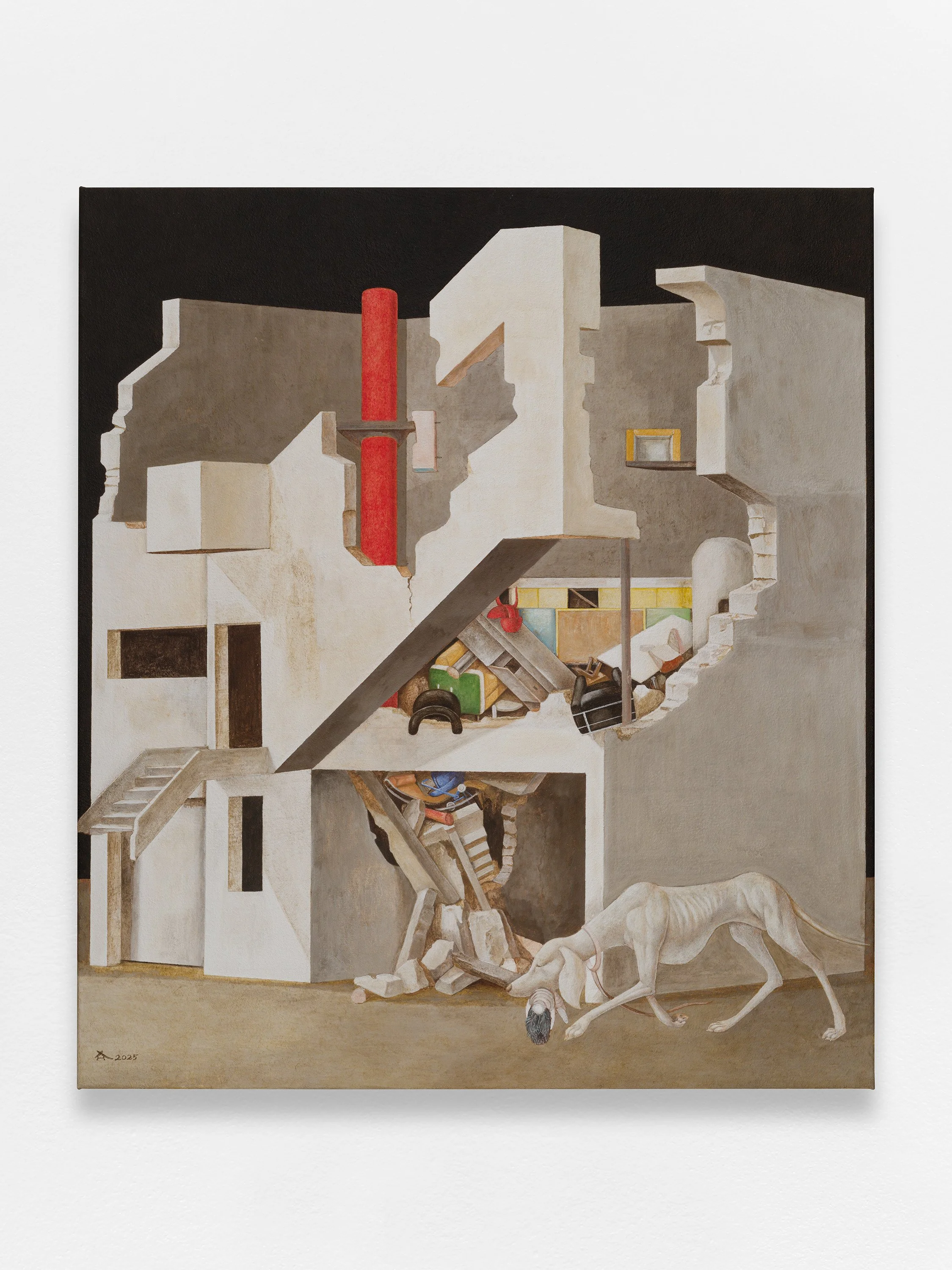
Xiao’s practice draws deep visual and spiritual inspiration from Early Renaissance masters such as Giotto and Piero della Francesca. Aligning with the French philosopher Maurice Merleau-Ponty’s assertion that painting “reveals the invisible within the visible,” Xiao rejects mechanical, single-point perspective precision in favor of an embodied, manual and deliberately imprecise practice—the “three Hs” (Head, Heart, Hand) rooted in the tradition of “disegno”. Shades are achieved by layer upon layer of paint, until the light radiates from the canvas towards you. Contours are fluid; the representations are inventively impressionistic. Objects sometimes seem to merge from one thing into another. There is something happening everywhere.
In contrast to the distracted temporal flux of digital media, the artist utilises the static canvas to condense existential drama into a singular, contemplative image that preserves a quiet, maybe ironic distance from the visible world. One quickly moves from the big picture to interpreting individual occurrences. One simply gets caught up in making connections, marvelling, discovering and interpreting.
From this reflective stance, Xiao examines how modern society constructs certainty, rigid moral positions, and ideological divisions that function as new secular orthodoxies. Observing these social tensions from a distance with a mixture of seriousness and quiet playfulness, his paintings do not judge or offer moral conclusions. Instead, they invite viewers to reflect on the deep entanglement of freedom, belief, and conflict in contemporary life.
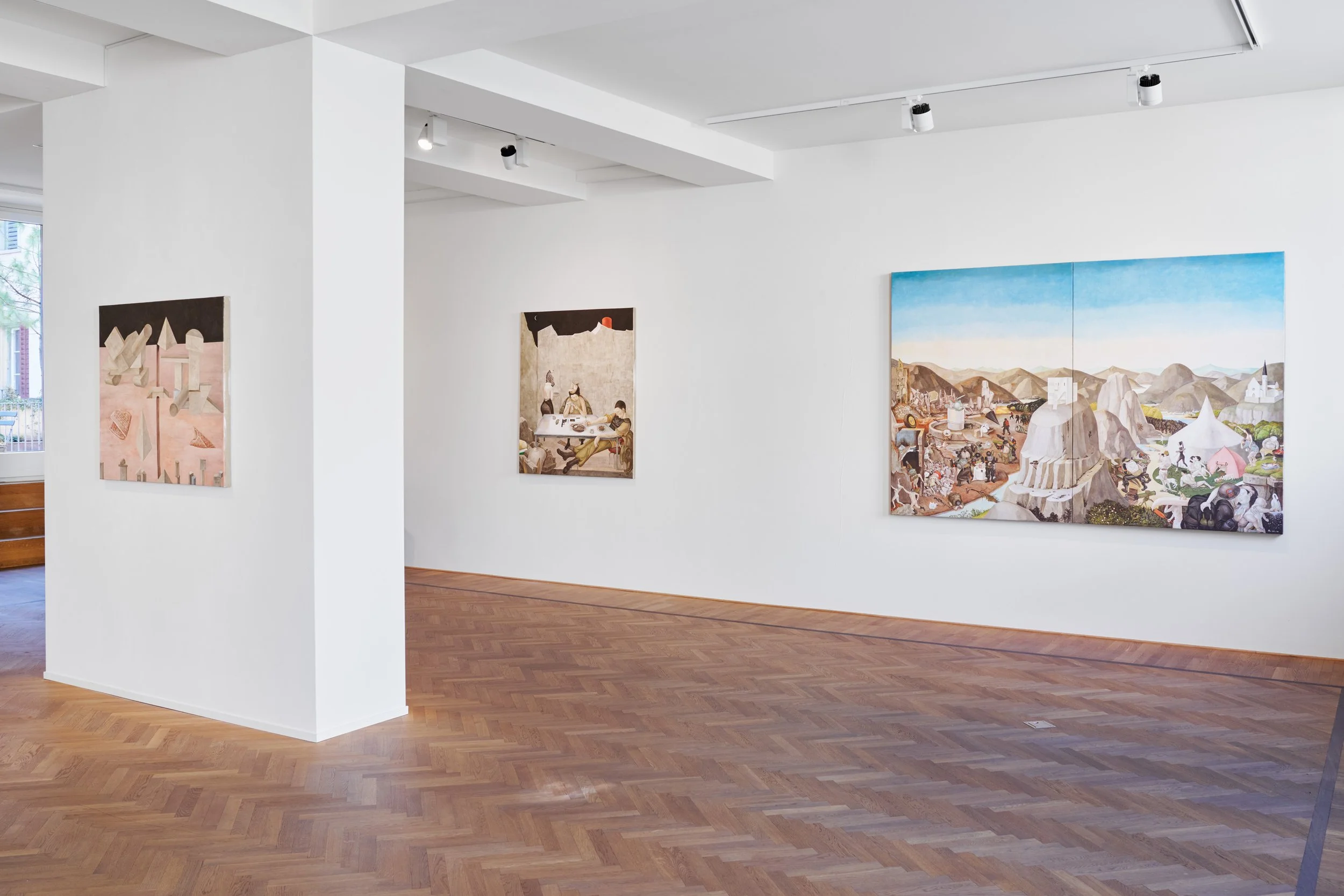
Three key works may exemplify the subtle thematic arc. The children’s game, 2026, shows what appears to be a close up view into a children’s block battlefield. Driven by an instinctive desire to compete and imitate adults, their game carries neither ideology nor allegiance. The second painting Les zebras, 2026 depicts three lions in an almost comic-book way, hunting a zebra on the savannah while the surrounding herds drink and mate undisturbed, exposing nature's evolutionary threshold of survival and apparent indifference. The third work This side of the mountain, the other side of the water, 2024-2026 is one of the key works in the exhibition. “It turns to humanity’s oldest affliction: war.” (Xiao), focusing on ordinary citizens watching far-off violence through screens across national borders. It explores how political propaganda legitimises destruction while geographic distance fosters a collective apathy. It’s all over Beaudrillard’s hyperreality again: “the representation of the war replaced the actual event, making the media broadcast the only "reality" viewers experience”.
We know better but since it’s intangible it doesn’t touch us enough. Are we naiv? Icarus, 2026 is asking: how close do we have to get before we get burned? Are we getting carried away?
Together, these paintings pose an unsettling question: “Is war an inevitable byproduct of human intelligence, or an atavistic impulse from which civilisation has never truly escaped?” (Xiao).
Just as when someone dies, Xiao’s works snap us out of our dull, listless existence and reveal to us what the ‘here and now’ truly is. Is this jolt to our consciousness not precisely the purpose of art? It performs the indispensable service of helping us to become aware again.
pressetext auf deutsch
[PDF]
Die Galerie Fabian Lang ist stolz darauf, ihre zweite Einzelausstellung mit Werken von Xiao Guo Hui zu präsentieren – eine zweijährige Auseinandersetzung mit den ontologischen Möglichkeiten der zeitgenössischen Malerei. Aufbauend auf seiner Untersuchung, was Malerei in einem von digitalen Medien geprägten Zeitalter leisten kann, nutzt diese neue Werkgruppe menschliche Konflikte, das Theater um Überzeugungen und die stillen Mechanismen des Alltags als Ausgangspunkt, um die zeitgenössische „Menschliche Komödie“ zu betrachten.
Xiaos Schaffen schöpft tiefe visuelle und spirituelle Inspiration aus den Meistern der Frührenaissance wie Giotto und Piero della Francesca. In Anlehnung an die Aussage des französischen Philosophen Maurice Merleau-Ponty, dass die Malerei „das Unsichtbare im Sichtbaren offenbart“, lehnt Xiao die mechanische Präzision der Zentralperspektive zugunsten einer verkörperten, manuellen und bewusst unpräzisen Praxis ab – den „drei Hs“ (Kopf (Head auf Englisch), Herz, Hand), die in der Tradition des „Disegno“ verwurzelt sind. Schattierungen werden durch Schichtung um Schichtung der Farbe erreicht, bis das Licht von der Leinwand einem entgegenstrahlt. Konturen sind fluid, Repräsentation erfinderisch impressionistisch. Objekte scheinen von einer Sache in eine andere überzugehen. Überall passiert etwas.
Als Kontrast zum ablenkenden Fluss der digitalen Medien nutzt der Künstler die statische Leinwand, um das existentielle Drama unserer Zeit in einem einzigen, kontemplativen Bild zu verdichten - dabei bewahrt er sich immer eine ruhige, vielleicht ironische Distanz zur sichtbaren Welt. Schnell kommt man vom grossen zur Deutung einzelner Begebenheiten. Man kommt aus dem Verknüpfen, aus dem Staunen, Entdecken und Deuten garnicht mehr heraus.
Aus dieser reflektierenden Haltung heraus untersucht Xiao, wie die moderne Gesellschaft Gewissheiten, starre moralische Positionen und ideologische Spaltungen konstruiert, welche als neue säkulare Orthodoxien fungieren. Indem er diese gesellschaftlichen Spannungen aus der Distanz mit einer Mischung aus Ernsthaftigkeit und zurückhaltender Verspieltheit betrachtet, enthalten seine Gemälde weder Werturteile noch moralische Schlussfolgerungen. Stattdessen laden sie die Betrachter dazu ein, über die tiefe Verflechtung von Freiheit, Glauben und Konflikt im heutigen Leben nachzudenken.
Legen wir den Fokus auf drei Schlüsselwerke, die einen subtilen thematischen Bogen veranschaulichen. Das Werk The children’s game, 2026, zeigt eine Nahaufnahme von einem vermeintlichen Schlachtfeld aus Kinderbauklötzen. Angetrieben von einem instinktiven Drang, sich zu messen und Erwachsenen nachzueifern, ist des Kindes Spiel weder von Ideologie noch von Zugehörigkeit geprägt. Das zweite Gemälde Les zebras, 2026, zeigt drei Löwen in einem fast schon comicartigen Stil, die in der Savanne ein Zebra jagen. Währenddessen trinken und paaren sich die umliegenden Herden unbehelligt. Das Bild offenbart die evolutionäre Schwelle zwischen Überleben in der Natur und scheinbarer Gleichgültigkeit. Das dritte Werk This side of the mountain, the other side of the water, 2024-2026, ist eines der Schlüsselwerke der Ausstellung. „Es wendet sich dem ältesten Elend der Menschheit zu: dem Krieg.“ (Xiao). Der Fokus liegt dabei auf den normalen Bürger, der auf Bildschirmen über nationale Grenzen hinweg, fern scheinende Gewalt mitverfolgt. Es beschäftigt sich damit, wie politische Propaganda Zerstörung legitimiert, während geografische Distanz eine kollektive Apathie fördert. Und wiedermal dreht sich alles um Beaudrillards Hyperrealität: „Die Darstellung des Krieges ersetzte das tatsächliche Ereignis, wodurch die Medienübertragung zur einzigen ‚Realität‘ wurde, die die Zuschauer erleben.“ (Baudrillard: The Gulf War Did Not Take Place)
Wider besserem Wissen, berührt uns die Sache zu wenig, da sie Ungreifbar ist. Sind wir naiv? Das Werk Ikarus, 2026 fragt: Wie nahe müssen wir sein, bevor wir das Feuer spüren? Lassen wir uns zu sehr mitreissen? Überschätzen wir uns?
Gemeinsam werfen diese Gemälde eine beunruhigende Frage auf: „Ist Krieg ein unvermeidliches Nebenprodukt der menschlichen Intelligenz oder ein atavistischer Impuls, dem die Zivilisation nie wirklich entkommen ist?“ (Xiao).
Ähnlich, wie wenn jemand stirbt, reissen Xiao’s Werke uns aus dem stumpfsinnigen Dahinleben heraus und führen uns vor Augen was das Hier und Jetzt ist. Ist dieses Wachrütteln nicht genau die Aufgabe der Kunst? Sie leistet den unentbehrlichen Dienst, dass wir wieder wahrnehmen.
This side of the mountain, the other side of the water, 2024-2026
Egg tempera on linen in two (2) parts
Total: 150.00 x 220.00 cm, 59.06 x 86.61 in.
Each panel: 150.00 x 110.00 cm, 59.06 x 43.31 in.